Showing posts with label judaism. Show all posts

15 January 2012

Packing lunch


Auschwitz-Birkenau: selection site
Matt went back to college today. It's a long trip for him: a plane, a subway, a train, and then a taxi. I got up early to pack him a lunch he could take with him.

Packing lunch -- an ordinary act I used to take so for granted when the lunches came two a day, every day. Now, it's almost a sacred act, feeding my children when they allow themselves to be fed by me. But, in that quiet kitchen, the rectangle of torn wax paper on the counter brought with it all the mothers who carefully packed food for a trip they didn't
Auschwitz-Birkenau: end of the tracks
want to take. They had no idea where they were going or what they'd find when they got there but they did what mothers do -- they packed food. They probably stood in their kitchens, terrified, but they did what they could do.

Long after the carefully wrapped food was eaten, too many of them sat on their suitcases, with their children all around them, in the stand of beautiful trees, and waited their turn.

It would be a lot easier to move through life wrapping sandwiches in oblivious peace...but I'm not sure I can do that ow that I know, now that I have seen.

For the moment, contentment with not knowing, not realizing, not seeing what happened, feels like sleepwalking to me.


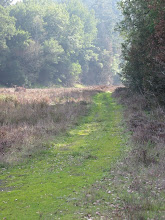
Auschwitz-Birkenau: the woods near the gas chambers


31 October 2011

Stacks of paper


After dinner, I came early to the first group meeting and the room was empty except for Andrzej Krajewski, the coordinator of the retreat from Poland. He was busy sorting stacks of paper so I asked if he wanted help.

"Yes, take from here," he said, indicating the box next to him filled with stacks of paper, "And please count twenty or twenty-two pages and put them in piles here."

Okay. I started to count, to stack. I assumed I was creating piles of twenty-two copies of the same document. But, as I counted, I started to notice that, no, each page was different. They weren't the same document.

"What are these?"

"These are names of the people who were recorded at the camps, the ones who made it through the first selection and actually worked at the camps before they died. No one knows how many actually died at Auschwitz because many were sent directly to the gas chambers so their names weren't recorded. There is no record of them."


There were at least twenty to twenty-five names on each page and a box full of pages. We were making piles of the names we were going to read aloud over the course of the retreat.

When we were done making all the piles we needed, the box was still full of paper, still full of the names of the people who had died in the Auschwitz camps, many more than the pages we had counted out. Andrzej picked the box up and walked towards the back of the room to put it away for another time. I wanted to grab them from him, to tell him no, not again, we can do it, we can do them all. We have to.

But we couldn't. We couldn't do them all. There were too many for the time we had.

There's a reason why people don't come to places like this. Whatever you do, you have it ground into your face, into your gut, into your bones, again and again, that it can never be enough. There is no matching this horror with anything "appropriate."

I sat down in that big empty hall filled with chairs and couldn't even cry.


Auschwitz One...


The Polish coordinator of the retreat, Andrzej, a tall, gray-haired bear of a man with warm sad eyes, opened our first meeting as a group with these remarks:  "Tomorrow is a very special day. It's the most important holiday in Poland: it's the day of all the saints. You go out to the cemeteries to honor your families, your dear ones, so Poland is in a very special state of mind these days.

"One more thing. Oświęcim, the name of the place, is an old Polish name that means 'enlightened place or place which is made holy.'"


Holy place. Enlightened place. Auschwitz?

We came to Auschwitz I for the first day of our retreat to hear and see what happened here.

I didn't realize that Auschwitz (the German translation of Oscwiecim) is really a constellation of three concentration camps: Auschwitz, Auschwitz-Birkenau, and Monowitz-Buna. Auschwitz I, originally a Polish military barracks, was the administrative center for the camps. It was also, they told us, where the use of Zyklon B gas to kill people was developed and perfected.

We walked underneath the "Arbeit Macht Frei" ("work sets you free") sign and to our first stop: the original crematorium, the first one the Nazis built for the purpose of killing people with gas. Once the entire group crowded inside the poorly lit room, Bernie Glassman who started the Bearing Witness Retreat more than 16 years ago, said, "This is a gas chamber. At Birkenau, where we will spend the rest of our days, it was much more efficient, many more people were able to be gassed at once. We're about 105 people. Normally the gassings that took place here there were 700 people...in this space. And the largest that they know of was 900 people. The crematorium is next door."

The first gas chamber

The official description of the retreat says that our main teacher is this "Place", these camps where unimaginably horrific things happened. While the retreats are organized by Glassman who is a Zen Roshi (abbot) and the Zen Peacemakers, they are explicitly multi-faith. In addition to the many Buddhist leaders, with us were an Hasidic rabbi, the German priest who ran the Center for Dialogue and Prayer where we were staying and even a Native American tribal elder.

Okay, I note that I just tried to duck writing about how I felt in that cement room by giving you admittedly relevant information but not the most important information. The important information is that I was afraid, that I kept not just imagining what went on in that room, but also the how and the why of it. The important information is that I kept trying to stand inside the brains of the people who didn't die here, the people whose job it was to run this place, the ones who came to work here each day day, and who, on occasion, joked around a little with their co-workers, who ran out of paper clips or ink for their pens and had to go get more, who took a break from the gassing and burning of bodies to eat lunch, who sometimes stopped off for a beer with friends after work, then went home, washed their faces, brushed their teeth, and got in bed to rest for another long, hard day at work. The important thing is that, if Auschwitz was the teacher, I was terrified of what it was going to teach me.

In Zen Buddhism, the stories we tell ourselves are something to notice and then leave behind. But what is there below, beside, or beyond this story? On its own, this "story" is so impossible to take in, to know, that I was quite certain at that moment I did not want to go beyond the facts of what happened, that whatever is beyond, beside or below it, felt like The Unnameable dread that lies inside our worst nightmares, our existential fears, our moments of terror, not just that there might be no meaning or point but, worse, that there is some shapeless malignancy just beyond what we can know. What I knew, as I stood there in that place of horror, was that I did not want to learn what this Teacher had to teach me.

We followed our guides out. Below are photographs of what we saw, ending at the execution wall where we had a ceremony. Because it was All Saints Day one of Poland's most important holidays, people had left memorial candles and flowers at most of the killing sites, especially the execution wall. One final note: I was completely unprepared for how beautiful it was, especially with the fall color. The guide told us many of the trees were there at the time, some were planted by prisoners, so they had this fall color to look at, too. However, it was only high overhead. We were told that none of the trees had leaves within reach of the ground because people had eaten them. The grass, too.

(A note to my retreat-mates or anyone who might be reading my blog for the first time: this entire effort is a work in progress and depends on the corrections and additions of people who know more than I do. Please do not hesitate to give notes, to comment, or to send any additional thoughts ...) 


Zyklon B pellets & canister  

Our Polish guide


No one spoke as we walked through
and we were not all in one group
...yet everyone who had a camera ended up taking
a picture of this shoe

How can one specific pair of shoes
have the power of a pile of thousands of shoes? 


Note that the windows overlooking the execution wall are boarded up
so people in the building won't be disturbed by the sight


Execution wall on All Saints Day


30 October 2011

The House

Gemmon looking for Amon Göth's house
Gemmon came to Krakow with one site she wanted to be sure to see: Amon Göth's house and I went with her. She knew about the Plaszow concentration camp commandant from the survivors' stories she's read as well as a book by Harold Welzer, that hasn't been translated into English yet: Täter or Perpetrator: How Ordinary People become Mass Murderers that she's been unable to read more than fifty pages of -- it was too painful. Plaszow was just outside of Krakow. Gemmon said she wanted to see the second floor balcony where some accounts -- including Stephen Spielberg's movie Schindler's List - say Göth stood and shot prisoners when the mood struck him.**

We found the house the guidebooks list as Amon Göth's house fairly easily: 22 Heltmana.

It's for sale.

Amon Goth's house

I wonder how long it's been for sale...and who on earth would buy it?

But it was the balcony on the back side of Göth's house that we came to see and it sure wasn't easy to figure out how to get there.

We walked back down to the entrance of the Plaszow concentration camp site.The Nazis tried to wipe out any evidence of the camp before the Russian army came so all that remains of Plaszow is an empty expanse of land with awkward man-made hills, worn signs marking the perimeter, and some memorial monuments.  The sign asks that people "please respect the grievous history of the site."


One of the signs marking the site
where Plaszow once stood
What the Plaszow site looks like now

It was just before All Saints' Day so there a few candles and some fresh flowers by the stone marker near the entrance. But there were no markings, no path, and we had to wade through brambles and low scrubby brush to be able to a place where we could see Göth's balcony through a chain link fence.

The back of Amon Göth's house.
It's hard to see but the balcony
is in front of that second story wondow 
From the back, it was clear that someone is living in the house -- there were clean lace curtains over the windows. I don't know why I found this so shocking, but I did. Then I remembered that, when the Germans invaded Poland, they took over most of the buildings so, when the war ended, there were few buildings that couldn't have been set aside as scenes of atrocities or, at the very least, occupation. Still, that the house is listed in guide books as the former home of Amon Göth yet someone is living in it and anyone can buy it as if it were just another house.

In the Schindler factory museum, one fourteen-year-old girl's note described being taunted and jeered as she walked down the street."It's not good being Jewish," she wrote. How often have I felt that way, relieved that I wasn't "fully" Jewish, embarrassed that I was partly? More often than I'd like to admit, even to myself. The Holocaust made one thing very clear to me as a child: there was something very, very wrong about being Jewish if an entire nation of people would want to kill you - or look the other way while others killed you - just for being Jewish.

And I can't even write this off to a crazed group that doesn't exist anymore. I went to school in a community that did not allow Jews to join their clubs. In the late 60s and early 70s. I had classmates in elementary school, in high school and even at Harvard who ridiculed Jews in front of me...and I kept quiet, I am deeply ashamed to admit, because part of me was relieved because it meant that they didn't know I was part Jewish. I have been told, on more than one occasion when someone's found out that my father's family was Jewish, that I don't "look Jewish." What does that mean? Was I, am I Jewish? To whom? We celebrated Christmas (presents) and Easter (candy). I was never taught a single thing about Judaism. Yet if I lived in Germany in the 1940s, I would have been Jewish enough to end up in Amon Göth's camp.

I don't really know what not looking Jewish has actually meant except that, because of it, I have been privileged to hear just how antisemitic some people are. I have heard people say that Jewish people "eat weird food", are "money grubbing", and that "if you throw a penny, a Jew will chase it."

I'll never forget one afternoon in the summer after my freshman year, my preppy boyfriend and his best friend came to my house to stay for a weekend. Both were classmates of mine at Harvard. I'll call Preppy Boyfriend's pal "Paul." "Paul" was the wise-cracking grandson of a prominent New England politician. When my best friend from high school, Naomi, came over, "Paul" made it pretty clear he wanted to sleep with her. Naomi was Jewish. She was gorgeous. Yet, when Naomi was playing the piano, her attention on her fingers, "Paul" put his two fingers up over his own tiny up-turned nose to mimic the shape of her's. My boyfriend laughed.

I did not kick them out of my house. I did not break up with my boyfriend right then and there. I watched all of this and said nothing.

Within a few years, Naomi got a nose job.

But what does all this have to do with faith? With religion? With belief? Does it at all? Just because there are antisemites, people who dislike Jews, they say, simply because they are Jewish, (and others like me who say nothing while it's going on) does this really have anything to do with religion? When religion is used as a pretext for war or atrocities, are my parents right, that religion, itself, is to blame? And, while this kind of hatred makes the desire for a separate land filled with only people of your same faith make sense, where do you get this land free of others? Can you get it without doing to others what was done to you?

I just cannot go here, into the confused place where land and faith, property and religion, power and belief  get jumbled together...at least not right now. But is it meaningless to try to understand the beliefs and practices of faith while ignoring some of the ways these groups of believers have behaved towards others? The way I stayed silent while group hate and disrespect happened right in front of me?

As a religious blank slate, I really have no choice but to start at the beginning: what do people believe and how do they manifest that faith in their every day lives? But the question of what goes wrong after that -- and why -- is always lurking.

I am so confused by all of this and I'm starting to realize just how much of my ignorance has been self-inflicted, a choice I've actually made as if the less I knew about these horrific actions and times, the less it has to do with me and my little life. Well, it does have something to do with me, whether I choose to know something about it or not, whether I choose to look at it, to see it, or not. Human beings like me did these things. Human beings are still capable of doing these things. Human beings are still doing these things in large ways and in small ones, every day, so it does, right now, have to do with every one of us. And it certainly has to do with me. I am capable of the kind of personal cowardice that allowed the Holocaust to happen.

~ ~ ~

**There's an argument about where Amon Göth actually stood when he shot people.  Stephen Spielberg's movie, Schindler's List, shows Göth shooting people from the balcony of his home but others argue the location was elsewhere. A documentary in which Amon Göth's youngest daughter spoke shows the balcony of the house at 22 Heltmana. Under any circumstances, Göth was responsible for the deaths of hundreds of people and even the Nazis considered him mentally ill. He was actually taken into custody by the US military from a mental institution where the Nazis incarcerated him in 1944. Here's the United Nations War Crimes report about Göth which only says that he did shoot people himself but doesn't go into any more detail than that.


The concentration camp in Plaszow near Krakow 
erected by nazi-Germany in 1942.

Amon  Göth on the balcony of one of the
places that he lived.
Clearly this is not the same balcony
as the house Gemmon and I saw.


Amon Göth's daughter, Monika
She was interviewed in a documentary about
her father in front of the balcony Gemmon and I saw


Oskar Schindler's factory...


On the way to find Amon Göth's house, Gemmon and I stopped by Oskar Schindler's factory.

I don't know where I thought Oskar Schindler's factory was but I know I didn't think it was just on the edge of Krakow. In fact, if you walk from the central market square, you walk through the old Jewish community  (Kasimierz) to get there. Nearby is one of the two remaining sections of the old ghetto walls that are still standing.(for more about the Krakow Ghetto...)

One of the two remaining sections
of the Krakow Ghetto wall
Their tombstone-shaped cement still looks oddly fresh more than sixty years later.

The permanent exhibit at The Schindler factory is called Krakow Under Nazi Occupation 1939-1945 and it's devastating. It's a fairly confusing exhibit in that you feel like you are supposed to walk along in proscribed direction but it's never all that clear which way you are supposed to go and most of the ways to go are narrow, wind around small exhibits in a warren of tiny rooms, some with staircases between them. Twice, I followed a staircase to a complete dead end. It's made even more challenging by the fact that many of the museum exhibits aren't explained or set in context.

One example is this exhibit of marionettes... 

Puppets in the Schindler Museum

Whose were they? Why were they made? Who used them and where? Without that information which I could find nowhere -- either in the museum or online -- it's hard to know how to react to these puppets.

Another example is the very first exhibit I saw, a black and white film that played in a monitor set on a slant. It was a documentary about Jews made for who knows what purpose that may have meant to be supportive but the subtitles talked about how "they" "scurried to work", "liked playing in the park" and "of course, talked about work." It had no label that explained the source of the film, or even when it was made, so it compounded the horror of walking through room after room of evidence of group hatred by making me nervous that the museum was trying to stake out some separate, defensive position for the Poles -- either that they were just as victimized as their Jewish citizens or that they were, ultimately, heroic. Mercifully, this didn't turn out to be the case at all - the museum was an incredibly powerful and moving experience - so I can only think this museum is new enough that it hasn't the money or manpower to work out all the kinks quite yet. I write all this to say that, if you go, walk through to the end. I was so put off and confused by the beginning, I almost didn't.

I was especially happy to be there with Gemmon because I would have missed the full horror of the hall of proclamations that were issued by the Germans when they took over Poland in 1939. Before the Nazis got  their public address speakers installed all over Krakow, they issued orders to the populace through orders plastered on the walls in both Polish and German. The Schindler factory museum has created an exhibit you walk through with those orders from floor to ceiling on either side of you. Gemmon translated them for me..


"All Jews and Poles are required to bring their cars to be inspected and registered."

"No one who isn't Jewish can go in to a Jewish business and all businesses whose ownership was more than 50% Jewish must prominently identify themselves as a Jewish business."

"Everyone must turn in any guns or uniforms they have. Anyone found with either of these after (a certain date) will be shot."


It went on and on. And there was a horrific snapshot of a couple of jocular Nazis, smiling for the camera, as they took scissors to chop off a random man's beard and side curls.

By the end, Gemmon and I couldn't speak. We sat, for a bit, near some production stills from the Spielberg movie in the museum's "Movie Cafe". To be reminded of Hollywood felt a bit incongruous but, if it hadn't been for Stephen Spielberg, his movie and his money, there probably wouldn't have been a museum there at all. We then set off to find the house of Amon Göth. Gemmon has the address from a guide book and she led the way.


29 October 2011

Gemmon in Krakow


Never plan to see a friend you haven't seen for almost two years for the first time at 10pm if you want to get any sleep.

When I got back from visiting Luke, Gemmon was in the hotel. We started talking that night and stopped long enough to get a few hours of sleep before setting off first thing in the morning in search of Amon Goth's house, the infamous concentration camp commandant of the Płaszów camp on the outskirts of Krakow.

I'd forgotten that Gemmon had decided to become a Buddhist, in part, because of the Holocaust. About 40 years old now, Gemmon and her generation grew up in Germany with their faces shoved squarely into their country's culpability for the atrocities committed by their elders during Hitler's reign of terror and it's hard to imagine anyone more fearless and obsessed with owning the full weight of that responsibility than Gemmon. She knew so much more about precisely what happened than I did. To this point, I've learned only what I had to about the Holocaust, what came towards me at school and in popular entertainment but Gemmon told me she first began reading the accounts of Germans who lived through the period because she wanted to know "how in any possible way they could have survived this without feeling failed as a human." Then she began to read as many of the survivors' written accounts as she could as well as the diaries of people who were killed in the camps. "I kept asking myself: could I?  Would I?  Finally, this was the reason I got into practice."

Gemmon hadn't changed much in the year and a half since I saw her last. She no longer has the shaved head of a Buddhist priest, although she remains one, she says, "for now." After things didn't work out at the Zen Center, Gemmon went back to work as a hospice nurse, this time in Zurich. I asked if she missed the zendo, missed Los Angeles. She teared up. "I sometimes miss the Pacific and I sometimes miss Roshi but never the Pine House." (where Roshi lived and the workplace personnel conversations took place.) And Gemmon added that she didn't think she'd have a teacher like Roshi or live in a community like that again but that didn't mean she was no longer a Buddhist priest. "For me, my robes are alive."  While Gemmon had clearly processed her feelings of loss - much of into gratitude - still, after almost two years, Gemmon's hurt seemed fresher than I expected.

I cannot continue to feel this way for two more years. Perhaps it was just that, in catching up, my more recent parallel tale of job woe stirred up her old feelings...or maybe it's that, while I only lost a job, Gemmon lost a job, a home, a teacher, a way of life, and a country.

We'd come to the Auschwitz retreat for slightly different reasons. I'd decided to come to leave behind my tiny ego bruises, to plunge fully and completely back into this effort, and to begin my approach to Judaism. Gemmon's reasons, the questions she was asking, were much more complex. "I don't think it's difficult to have compassion for the victims, but the perpetrators? Is it possible to have compassion for them? I've read their stories. I've heard them talk. They don't have nightmares. They compartmentalize what they did. They killed people - for them it was just another day at work -- then they went home to their children. How do you have compassion for that?"

Am I supposed to have compassion for that? What happens if I can't?

This is the really tough part of Buddhism, the dark side of "we are all connected, interrelated."

Gemmon said, "You are right that it is tough but I think it is actually even tougher to be attached to our hatred as we are suffering under it." She sent me a verse of the Dhammapada about this which is below.

 I guess that's what we are all here to face at Auschwitz and Birkenau. For a week.


The verses of the Dhammapada that Gemmon sent 
Never here by enmity
are those with enmity allayed,
they are allayed by amity,
this is the timeless Truth.

Hatred is, indeed, never appeased 
by hatred in this world. 
It is appeased only by loving-kindness. 
This is an ancient law.

For hate is never conquered by hate.
Hate is conquered by love.
This is an eternal law.


1:1 (1)
The mind is the basis for everything.
Everything is created by my mind, and is ruled by my mind.
When I speak or act with impure thoughts, suffering1 follows me
As the wheel of the cart follows the hoof of the ox.

1:2 (2)
The mind is the basis for everything.
Everything is created by my mind, and is ruled by my mind.
When I speak or act with a clear awareness, happiness stays with me.
Like my own shadow, it is unshakeable.

1:3 (3)
"I was wronged! I was hurt! I was defeated! I was robbed!"
If I cultivate such thought, I will not be free from hatred.

1:4 (4)
"I was wronged! I was hurt! I was defeated! I was robbed!"
If I turn away from such thoughts, I may find peace.

1:5 (5)
In this world, hatred has never been defeated by hatred.
Only love2 can overcome hatred.
This is an ancient and eternal law.

1:6 (6)
Everything will end.
When I understand this, all quarrels fade away.

1:7 (7)
As the wind topples a brittle tree
So will temptation3 topple me
If I am lazy, unrestrained, apathetic, seeking only endless pleasure.

1:8 (8)
The wind cannot uproot a mountain.
Temptation cannot uproot me
If I am alert, self-controlled, devout, unmoved by pleasure and pain.

1:9 (9)
The saffron robe4 is perfectly clean
But I am not ready to wear it
When I have not cleansed my spirit,
When I disregard truth and neglect to practice self-control.

1:10 (10)
When I have removed all defilements,
When I am filled with self-control and truthfulness,
Then I am truly worthy to wear the saffron robe.

1:11 (11)
When I see the truth as false,
When I believe illusion to be reality,
I am unable to find the truth.

1:12 (12)
I must see the essential reality as real,
And discard illusion.
Only then can I find the truth.

1:13 (13)
As heavy rain will penetrate a poorly-thatched roof,
So passion creeps into an unreflecting mind.

1:14 (14)
The rain will not penetrate a well-thatched roof.
Passion does not enter a tranquil and reflecting mind.

1:15 (15)
I grieve now, and I grieve in the future.
When I do wrong, I am doubly-grieved.
I mourn and suffer when I see the results of my actions.

1:16 (16)
I rejoice now, and I rejoice in the future.
When I am virtuous, I doubly-rejoice.
I smile and give thanks when I see the results of my actions.

1:17 (17)
I suffer now, and I suffer in the future.
When I do wrong, I suffer doubly.
It pains me to know that I have done wrong,
And it pains me even more to see the consequences.

1:18 (18)
I am happy now, and I am happy in the future.
When I am virtuous, I am doubly happy.
I am delighted to know I the good I have done,
And I am even more delighted to see the consequences.

1:19 (19)
Even if I can recite large portions of sacred texts,
If I do not put those into practice
Then I am like a shepherd counting someone else's sheep,
No closer to enlightenment5.

1:20 (20)
If I know just a little of the sacred texts,
But I put those teachings into practice,
Casting off desire, ill-will, and delusion,
Practicing wakefulness and meditation,
Free of attachments to anything, here or in the future,
Then I may become enlightened.


27 October 2011

Beginning with the Holocaust?


Krakow - main square 

When I landed in Krakow, I started to think about my relationship to Judaism. Let's just say I think it was a good thing I decided to begin The Heathen with religions I knew absolutely nothing about:  Hinduism and Buddhism. The next three - Judaism, Christianity and Islam - are going to be a challenge because of what I think I know, what I don't know, and what any readers of The Heathen know and feel about these religions.

Why am I going through the training for these faiths in this order? To begin with, because of basic chronology. Judaism came first, then Christianity, then Islam. But the relationship between the "religions of Abraham" is deeper than that, of course: Christianity was built on the foundation of Judaism, and Islam was built on the foundation of both Judaism and Christianity. Makes sense to start at the beginning, right?

Okay, so it's important to bring out any baggage I've got before I begin. I've always thought that Judaism and Islam would be the toughest for me, the ones that would require a bit of airing out of old ideas so I can start with as open a mind and heart as possible: Islam because of 9/11, Judaism because of family.

My father, who is now a devout atheist and, in fact, against religion of any sort, was raised in a Jewish home. Sort of. He was a bar mitzvah at thirteen but more because of his grandparents than his parents. His wise-cracking, playful father and more sharp-edged mother cared about cards, family brunches and traveling. My grandfather died playing pinochle with friends. I don't remember my grandfather or grandmother in any religious event or ceremony. The most religious person in my father's life was his grandmother, Bertha. "She used to bribe me to go to synagogue with her," my Dad said. "If I went with her, she'd take me to the movies after, the ones with the show and cartoons before. So sometimes I'd go. She was a lot of fun."

I think if my father had married someone more observant, he might have gone along with it but he didn't. My mother has no use for groups of any kind or anything she considers weak and the need for belief of any kind,  she feels, involves both. Her father felt the same, a bah-humbug man, for sure. He was born in the United States in 1896, shortly after his family came here from Poland and grew up in Irish-Catholic South Boston, the son of a Jewish doctor. That couldn't have been easy. Her mother, Opal, was my only grandparent with any vestige of religious feelings left over from her Methodist up-bringing in far northern Maine, but it was a pretty pale remnant: she cared a lot about having the palm leaves in the shape of a cross in her home on Palm Sunday.

Together, my parents feel quite clear that things like 9/11 and the Holocaust -- and virtually every war going back to the beginning of time -- have been caused by religion. Far from being a positive force in the world, they really believe it is the root cause of dissension and hate. It's not hard to see why they think that.

As for me? I have felt completely frozen by this concept. Just because someone claims to act in the name of a faith, is the act caused by that faith? If I rob a store and claim that I'm doing it in the name of Mickey Mouse, is Disney to blame? But, given how little I know about any religious tradition at all, I've been pretty much stuck having to listen to pundits -- never a good place to be.

This explains part of the provocation for The Heathen but I need to get back to laying out my personal baggage as I begin to learn about Judaism. When it's family baggage, there's always more, right?

My father's sister married a guy who was in the Army with my father in the Korean war. My aunt and uncle became fairly observant of certain Jewish traditions, especially Passover. We were invited every year and, in spite of my mothers deep-seated discomfort with my father's family and with any religious traditions at all,  we went. We went and my mother made quiet quips about the proceedings to whichever one of us was next to her and spent the car ride home picking at the moments she felt were full of it. It didn't help that my uncle loved being the center of attention in a kind of creepy way and that we had other reasons to be deeply uncomfortable with him. So the only practice of Judaism I really ever witnessed was all tangled up in uncomfortable family dynamics.

Anyway, for better or worse, the little personal contact I had with any religion as a child were these Passover seders and the Christmas plays at my Episcopalian school. Which brings me to the final piece of baggage to trot out: shame.

I cannot mince words: I went to school in a deeply antisemitic, bigoted community. I know this because girls in my class would tell me what they thought of Jews in general and the Jewish girls in our class in specific. In middle school my friends all went to dance class, ballroom dance class with mandatory white gloves, at a club that did not admit Jews or blacks. Catholics were just getting the privilege of admission.  I was told that Jews ate funny food, didn't get to have fun at Christmas, and were cheap. "Drop a penny and see if she picks it up!"

Yes, girls in my school did this to classmates of theirs.

In my neighborhood, we played games nonstop including tackle football and our made-up game of Spy. Dory Strittmatter always loved playing the villains. His villain of choice: the Nazis. One day, when I was about eleven, my brothers and I were playing football with the rest of the guys on the cul de sac. My brother, Robbie, somehow mentioned that we were Jewish. On the way home I took him aside and hissed at him: "Never tell people we are Jewish because we aren't!"

When I got older and it became clear that I was, according to my school classmates, part Jewish, they thought they were paying me a compliment by telling me that "you don't look Jewish."


One of the few remaining
synagogues in Krakow
But, even if both my parents were Jewish, if they taught me nothing about it, why would someone consider me Jewish? Isn't faith something you practice? Something you believe? It makes sense that you tend to believe and practice the faith of your parents but it's not an inherited trait like eye color, right?

I used to joke that I wasn't Jewish enough for Jews but I would have been for Hitler.

So now you have all the baggage I come with as I begin Judaism.

Still, to start my Judaism studies with a visit to the epicenter of the hatred of the Jewish people (and Catholics, and gypsies, and homosexuals etc etc etc) feels a bit off. That hatred emanated from ideas that, really, had nothing to do with the teachings of Judaism. But, if the purpose of this project is to understand, in some kind of visceral way, whether hatred between people of faith has, in reality, anything to do with those faiths and what kind of response these religious atrocities demand of us, then perhaps Auschwitz is really the dark heart of the matter. And I don't think it's possible to learn about the practice of Judaism, as a child of the 20th century, without standing squarely in some earned knowledge of the Holocaust.

I'm not at all sure I'm equipped to handle this.

Memorial to the victims of the Krakow Ghetto
Plac Bohaterow Getta  


01 August 2006

Okay, here goes...

I've been at this for two years now and I'm getting buggy with all my time alone, keeping this all to myself, so I'm letting it out. My raw notes. As I go. Once I catch this blog up with real time, that is.

So, who am I and what have I been doing?

When my sons were six and four years old, they were arguing in the back seat of my car about whether or not God existed. Pretty soon a voice from the backseat asked, "Mom, what do you believe?"

All I could answer at the time was, "I don't know. I'm still working on it."


I am a blank slate. A tabula rasa. I come to the table with the fewest possible preconceived notions about any religious tradition because I was raised outside of any. Although there were rudiments of some religious traditions in parts of my extended family, my parents considered strong religious conviction the source of wars, hatred, and division among people. At the dinner table, on more than one night, they said religion was a crutch for those unable to handle the truth: that we're mortal, that “after life” we simply revert to the chemicals from which we're made. Nothing more.

Just chemicals? That's all we were? It didn't make sense.

One night, when I was twelve, I said, “I think I might want to, uhm, go to church.”

Forks clattered to the plates. "Well,” my mother said, “if you think you need that."

So, growing up, I knew nothing of any religious tradition. I tried to learn how to live, how to have a meaningful life, by reading books. Biographies were best; I was obsessed with them. Maybe if I could see the choices people made, and how it worked out for them, I might know how to live. The Bible was little more to me than a collection of stories that I learned about, one-by-one, when a teacher would point out allusions to them in novels or plays.

When it came time to get a job, I found one that allowed me to continue my obsession with the lives of others: I became a journalist. But my spiritual dissatisfaction didn’t go away. I just tried to ignore it. On occasion, a story would give me an excuse to learn about a religious tradition. A profile about the Archbishop of San Francisco introduced me to Father Miles Riley, who specialized in over-exuberant press management for the archdiocese at the time. We didn't get off to a good start. I thought all public relations people were only there to prevent me from doing my job with integrity. Our awkward beginning was made worse by my lack of experience with clergy of any sort crashing up against the vaudeville character of Father Miles, with his light yellow Cadillac convertible, his show-tune personality, and compendium of dirty jokes about his fellow clerics. He was not what I expected or even imagined as possible in a priest. We became friends, sort of. As friendly as one can be with someone wont to exclaim: “Oh, I love hanging out with the heathen!”

After that, I spent a bunch of years working on television newsmagazines which aren't very efficient tools for exploring faith.

Finally, in 2000, I decided to take two courses at a local college: an introduction to the Bible and a survey of world religions. By the end of the term, I felt relief: I had a basic grasp of what other people believed. I thought I'd taken care of this part of my life.

But I hadn't. I had factual knowledge but I found myself wondering what it felt like to actually practice a faith, to truly live by one. I went looking for books by beginners, people walking into a faith who might tell me what it felt like to learn how to practice it. I couldn’t find anything like that. And nothing came close to explaining the mystery of how a devout follower of any of those traditions could get from their faith, could get from the Golden Rule - some version of it is in every major religious tradition - to what I saw happening between people of faith all over the globe. If the faithful of different religions all believe they should do unto others as they would have people do unto them, if they were actually living lives based on doctrine, how could there be so much hatred and bloodshed in the name of those faiths? But, for all my newly-acquired, very basic understanding of the fundamental beliefs of various traditions, I wasn't one step closer to really understanding a thing I wanted to know.

Then I got one of those ideas people get while driving around or in the shower, the ones most people are sane enough to leave right where they found them. I began to wonder what would happen to me if I went through the conversion training - not to convert but to learn what a convert would learn - in the seven major religious traditions as identified by Huston Smith in his seminal work, The World's Religions: Hinduism, Buddhism, Confucianism, Taoism, Judaism, Christianity and Islam. Would I know something I couldn’t possibly imagine? Or might I end up at war with myself by the end, a riled nest of ideas, beliefs and practices in conflict?

Well, it's fine to have an idea, but actually doing this? I kept imagining my parents' reaction so I put it out of my mind and just confined myself to taking care of my two sons and doing my day job which was, at the time, running a regional public television newsmagazine.

Then 9/11 happened. My parents were the only people I knew who didn’t seem surprised at all; it was just one more item to add to their list of the damage religion has caused. But that act, and all that followed, finally made me feel like I had no choice any longer, that my personal confusion wasn’t something I could continue to shrug off as just that, personal. There was a life-and-death argument going on over the role of religion in our lives and I was disqualified from participating because I was an ignorant outsider.

And there was that question from my children, "Mom, what do you believe?"

So that's what I'm doing. I've decided to find out.

A note: If you're just joining up with me, especially for you first-timers to blog reading, it's in reverse chronologic order. You'll be grateful for this when you catch up to the most current post because the newest will always be what you see first when you come here but, if you've missed a lot, you might have a better idea of what's going in if you start with the oldest post and work forward.