Showing posts with label swami vivekananda. Show all posts

19 October 2006

Yoga and Thoreau...

…yes, they’re linked.

The firm control of the senses, is what is called yoga.

Katha Upanishad, II.iii 11

I end up in a few yoga classes a year and, about halfway through, I always feel like throwing up. “I want you to think of a string going right up your spine and out through the top of your head throughout the class today,” the blond woman said. “Sit up nice and straight, don’t strain, put your hands together over your heart space and we’re going to start with three “oms” to get centered and our breath working with us.”

Maybe it’s because I’m never sure exactly why I’m there – and I don’t mean just which way to bend. Am I there for exercise? For a stretch class? Is it supposed to be a physical spiritual practice? Is breathing the point? Meditation? In the past, I’d mostly gone hoping to find exercise that could counteract the effects of running so I found myself sprinting out of any shiny wood studio that spent too long on any kind of prayer. I wanted my spiritual lessons straight up, not slipped in when I was just trying to keep my legs from snapping.

But, that morning, while my head hung down just inches from the rubber mat, I knew what I wanted. I wanted to figure out how this kind of yoga fit in with all the other “yogas” I’d been hearing about in Hinduism.

In this softly-lit studio, the only reference to anything Hindu is a poster which looked like the symbol for “om” from far away but, up close, the gray “om” was actually made up of the smallest of human figures in yoga positions, a pretty accurate metaphor for what’s happened to the practice. I doubt anyone in the studio except some of the instructors think much about where yoga came from and why or that they’re actually engaging in a Hindu practice, albeit a pretty dilute form. I know I never had. In fact, I’d been confused when Professor Chapple started talking about yoga and “important” yoga studios as part of Hinduism’s journey west in the first abridged overview that he gave me about Hinduism in the United States but I’d simply scribbled down what he said. Somewhere in all those notes was the name of a documentary he called the best history of yoga he knew: Yoga Unveiled: Evolution and Essence of a Spritual Tradition. It was produced by Gita and Mukash Desai. I’d gotten through part of it before heading off to yogao class.

Yoga is an ancient practice. The word came from the Sanskrit word yuj or yoke. According to the film, archaeologists found representations of people in recognizable yoga poses in relics that date back to 2500 BCE which makes sense as what we call Hinduism was actually a collection of traditions dating back thousands of years before the birth of Jesus. No one person was responsible for its inception and it wasn’t even recognized as a single religion until centuries after it began. Its name came from outsiders who were describing the people living along the Indus river as “Hindus.” Originally an oral tradition, its earliest texts, the Vedas, were finally written down about 200 BCE followed by the Upanishads and the Bhagavad Gita. The practice we call “yoga” came from something called the Patanjali Sutras, a collection of 195 lessons or verses that were assembled by Patanjali somewhere between 1700 and 2200 years ago. Their purpose was to describe how the mind works and a set of physical practices to get beyond its false limitations.

Exercise was never the principal goal of yoga. If you wanted to learn yoga back in Patanjali’s time, you’d probably have to walk for miles to find a guru and then convince him to accept you as a student because the knowledge was considered secret. And the postures were actually the third step of eight on a path meant to lead, as Huston Smith put it, “to integration or union…of the human spirit with the God who lies concealed in its deepest recesses.”

For the physical postures to be effective, according to Patanjali, students had a whole lot of work to do. First, they had to abstain from violence in word and deed (yama) and then rigorously clean up the way they conducted themselves even when they thought no one is looking (niyama). Were you clean? Content? Able to handle austerities and rigorous self-study? Were you in complete surrender to the creator? Then, and only then, would a guru begin to teach the physical postures meant to control the breath, body and mind. The purpose of the training was to remove all obstacles, especially physical ones, to meditation. Maybe that’s why I always feel like throwing up. I’m pretty sure there isn’t much of those two preceding steps I’ve accomplished. I’ll bet that, if I’d truly taken those two steps first, my mind chatter would be less, too. Georg Feuerstein, author of The Shambhala Encyclopedia of Yoga, said: “Yoga without these foundations is a moral impossibility. It cannot fulfill itself. It cannot have the effect it was intended to have and it can truly not transform human life.”
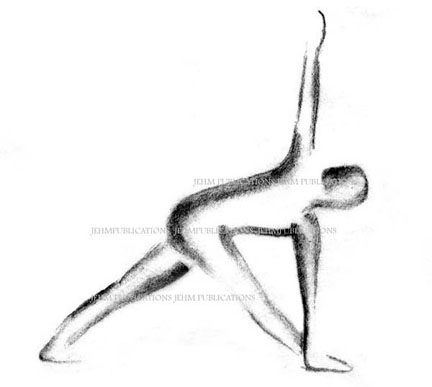
Utthita Trikonasana – triangle pose.” We were standing with our legs were spread wide, leaning forward, with one hand to the ground and the other stretched toward the ceiling. I suddenly remembered that you’re supposed to do yoga on an empty stomach.

The historian said the ultimate purpose of yoga had little to do with becoming fit and limber; it was really meant as preparation for the meditation that might lead one to uniting with the divinity inside each one of us. No wonder it was confusing in those yoga studios when the class ended and everyone leapt to make way for the next group coming in. Those last few minutes of silence and repose are much more important than all that comes before; they are, in fact, the point but that’s gotten lost in the emphasis on physical exercise and appearance.

The teacher walked between the mats, shifting a hip here and the angle of a foot there. I caught a glimpse of the clock. Just ten more minutes and one pose left. Good. The postures were no match for my chattering brain which pounced from commentary on the teacher; to rumination on the use of Sanskrit words when they’ve got perfectly fine English names for all the poses; to my assessment of my performance in comparison with those around me – better than the the guy in a baggy shirt but not even close to the pony-tailed woman in front of me; to a fixation on what the statue up front was (a skinny buddha – what did that have to do with yoga?); and then off again to the smell of the incense - was it bothering anybody? I could never use incense in my office without someone wheezing or gagging. And that summed up a scant thirty seconds of thought in a ninety-minute class.

But my hamstrings were better. I could feel that.

The instructor finally said, “Okay, lie down on your mats in Savasana, corpse pose.”

I dropped to the mat like a wet bath towel, making more noise than felt proper.

“Legs slightly apart, “ the instructor purred. “Then let them fall gently out to the sides. Let your arms fall alongside your body, facing upwards.”

I was whipped and warm, grateful for the stillness.

Within minutes, the teacher had us sitting up, legs crossed, palms together in front of our “heart space.”

Namaste

Namaste,” we repeated in unison. And then all around me, just as my mind chatter finally stilled, people began rolling up their mats and heading for their cellphones as the next class started to come in. I decided to go home to finish watching the documentary and what I heard next shocked me.

I’d gotten most of what I needed from the documentary – or so I thought – but I came home and, still in my sweats, sat there on the living room rug to finish watching the rest of the four-hour film on the history of yoga. And there, in the section on yoga’s journey west, was that yoga historian saying that the main people responsible for first bringing Hindu thought into this country were Henry David Thoreau and Ralph Waldo Emerson.

Thoreau and Emerson?

I’d read Walden Pond in both high school and college. I’d read Emerson in high school, college and many times since. I’d been assigned essays on both more than once. Yet I’d never noticed any of this.

Georg Feuerstein said that, while there was some evidence that Hindu thought was at least known by the ancient Greeks, it really wasn’t until the first English translations of the Bhagavad Gita, the Vedas and the Upanishads found their way into the hands of Henry David Thoreau and Ralph Waldo Emerson in the mid-1800s that these traditions had any significant impact in the United States. He said the Transcendentalists “were deeply affected by Indian thought. Thoreau openly uses words such as Brahman and words such as that.”

Of course Emerson’s “Over-Soul” was the Bhagavad Gita’s imperishable, unchanging “presence that pervades the universe.”
Within man is the soul of the whole; the universal beauty to which every part
and particle is equally related, the eternal One.
Of course, both Emerson and Thoreau stressed a direct, unmediated relationship with the Divine as Hinduism did in stark contrast to the religious practices of their day. Of course, Walden Pond was Thoreau’s Ganges, his time there his yogic retreat. In Walden, Thoreau had been explicit but, still, I hadn’t seen it, hadn’t taken it in.

In the morning I bathe my intellect in the stupendous and cosmogonal philosophy of the Bhagavat Geeta, since whose composition years of the gods have elapsed, and in comparison with which our modern world and its literature seem puny and trivial; and I doubt if that philosophy is not to be referred to a previous state of existence, so remote is its sublimity from our conceptions. I lay down the book and go to my well or water, and lo! there I meet the servant of the Brahmin, priest of Brahma, and ishnu and Indra, who still sits in his temple on the Ganges reading the Vedas, or wells at the root of a tree with his crust and water---jug. I meet his servant come to draw water for his master, and our buckets as it were grate together in the same well. The pure Walden water is mingled with the sacred water of the Ganges.
How could thought I’d considered so fundamentally a part of my heritage, so fundamentally American, have come, in part, from Hinduism? How could I have started this thing I’m doing with the most obscure, the most ancient, the most remote, the most exotic, the most unknown to me of the traditions and end up here? Inside the pages of some of my most treasured, well-thumbed books? And they were largely responsible for bringing Hindu thought to this country?

Emerson and Thoreau often get slammed for being so “self”-absorbed. This puts it in a different light, doesn’t it, if the “self” they were talking about was actually The Self? In other words, it's not them, in particular, they were trying to fully realize, but the Divine Self.

A few days later, I sat at the long wooden dinner table in the Vedanta Society's dining room after one of Swami Sarvadevananda’s evening classes when the subject came up of how Hinduism first came to the United States. Leslie, an American woman who was raised a Catholic but now wore saris from time to time, said, “It was Swami Vivekananda, wasn’t it? At the Parliament of Religions in Chicago the late 1800s?”

Swamiji’s Bengali-accented English is quite understandable but it’s easy to get tripped up, sometimes, by slight differences in syllabic emphasis. I’m really not sure if it was that or my assumption that the documentary had over-stated the case, or that I thought Hinduism had to have first come to the United States through the aegis of an Indian but I was thought I hadn’t quite heard him right when he answered, “No, it was Thoreau, Thoreau and Emerson who first introduced it here.”

“Thoreau? You mean Walden Pond Thoreau?”

“Yes.”

So here’s what I’ve learned about Hinduism so far: If you’ve ever participated in a Lamaze class or seen one on TV, if you think the state of your mind has some impact on your health, if you’ve been to a twelve-step program, if you are interested in astrology or meditation, if you think good or bad deeds might affect your future fortunes, if you can’t understand why such different ideas often seem to come from the crazy people in California, if you’ve read Ralph Waldo Emerson or Henry David Thoreau, and, most of all, if you’ve ever gone to a yoga class, Hindu belief, thought or practice has had some impact on your life.


(19 October 2006)

17 October 2006

Doing it...

Each soul is potentially divine. The goal is to manifest this divinity within by controlling nature: external and internal. Do this either by work, or worship, or psychic control , or philosophy – by one, or more, or all of these – and be free. This is the whole of religion. Doctrines, or dogmas, or rituals, or books, or temples, or forms, are but secondary details.

Swami Vivekananda


I went to learn some rituals. Swami Sarvadenanda said he’d teach them to me after aarti. It meant I had to figure out what aarti was.

The ritual worship of Ramakrishna at the Vedanta Society is easy to miss, at first. It wasn’t in the schedule the temple sent out every month but that’s because it happens every day at six in the evening. In its own quiet way, it was every bit as dramatic as the rituals at the temple in Whittier.

In a class, the swami had described the importance of ritual this way: “God is love. But how are we to know that?” he said, pausing as though one of us sitting in the class might actually answer him. “If you see a person who shows more love than is commonly manifested in everyday life, then you can use them as a role model. Like Ramakrishna. This is the source of the evangelical idea that you can only go to God through Christ. It’s important to see these spiritual giants as a role model so that we get encouraged to try to develop that kind of love.”

Okay, so the idea of revering a historical figure is starting to make some sense. I don’t think I can go so far as to worship Ramakrishna as though he were Divine but perhaps I can find traits of his worth admiring and even emulating although I’m not so good at the hero thing. It seems that everytime I get one, I look too close and they crash down.. Maybe I’ve looked for them in the wrong places like books, plays, movies, and biographies. Or maybe it’s because I demand too much of them. I’ve always thought heroes had to be perfect. Perhaps it's both of those reasons and one other: I doubt I could recognize a hero if I’d met one; I’m always too busy looking out for the clay feet.

Does it take death to fully recognize a hero? I deeply loved and admired my father-in-law while he was alive. When I think of a life lived on faith, I think of him, of his decision to become an orthopedist to help disabled children as Christ did and he did it outside his regular practice, without compensation, for his entire life. But it wasn’t until his death that this essential fact became untangled from the mundane family and human logistics which distracted from the truth, his truth, and now my truth. John didn’t need to be perfect to be one of my heroes. From his example I’ve learned what it means to live on faith and to give for no other purpose but as an exercise of that faith.

But it’s not easy with Ramakrishna. Even his main disciple, Vivekananda, the guy who started this sect of Hinduism called the Ramakrishna Mission or Vedanta here in the United States after Ramakrishna died, took quite some time before he fully appreciated his teacher. So what can I appreciate about Ramakrishna? I admire his unshakable desire to know the Unknowable and his single-minded devotion to the search, to know for himself. So I might not find myself swept away by spiritual ardor but I might be able to lay a flower at the base of his photo or get some sustenance from having his picture around the way I do from the photos of John on my mantelpiece at home.

At the aarti that night, everyone who came into the temple walked to the front, kneeled down and then most touched their heads on the clean carpet. I figured now was the time. No one much cared what I did or didn’t do. Plus, it was dark. So I walked up to the far side and did it: I kneeled down, touched my forehead to the carpet, and sat down on the floor.

All I felt was relief.

Whether or not it will ever be any more than that, I don’t know. Something about the idea of getting to the Divine through thinking of or reflecting on an example of someone who really tried, with every fiber of their being, to live a spiritual life makes it much less of a big deal. I’m not worshipping a picture or an icon so much as paying respect to an effort made, hoping to learn what I can from the act.

In half-light, Swami Sarvadevananda came in through a side door and stood facing the altar while a short-haired Anglo nun did all of the rituals which included a near constant ringing of the brass bell in her hand. Two congregants beat gongs while everyone chanted “Jai Sri Ramakrishna” - like Hemu’s greeting “Jai Swaminarayan” only with a different name. In the description on the website, it said the service was called “Arati” or Vespers; its purpose was “to remember that all we do is for God’s sake.”

The nun waved a brass candle holder followed by a pitcher of water, a folded piece of cloth, a flower, and a long fan made of hair from a yak’s tail which almost floated through the air when she was waved around. The bell ringing symbolizes the sound “OM” which is the symbol of Hinduism and also represents God (Brahman.) “The lights symbolize the light of Brahman (the Godhead). They also symbolize fire, one of the five elements that comprise the universe.” The water stands for itself; the flower represents earth; the flowing fan, called a chamara, symbolizes air; and the cloth represents space (as in cloth covers the body as space envelops all creation.) The point of the fire and the chanting of Ramakrishna’s name was to ask him to be present in the service.The nun moved each item with a rhythmic but slightly sensuous dance-like movement confined to her right arm while her left moved just enough to keep the bell gently ringing at her side.

When the ritual was over, a silent meditation began. Swami Sarvadevananda sat on a mat to the far right side of the altar, his back utterly straight, until the hour was over. By the time we opened our eyes, at the back of the chapel was a basket of flowers taken from the altar for people to take home with them.

The lights came on, the night class began and still the swami hadn’t had a chance to teach me a single ritual. After class, came dinner and I went to that, too, hoping he hadn’t forgotten.

More than twenty people sat down to eat, a number of them guests from out of town. I scooped the little food I took – rice and spiced vegetables along with homemade bread – off the paper plate and into my face as quickly as I could. In an awkward moment, the Swami abruptly excused himself from the long table and motioned for me to follow him into another room for a few private words, not my idea of how I wanted this to go. I couldn’t forget the large group eating, waiting for his return.

For the daily rituals and an explanation of their meaning, he suggested I get a small book called The Worship of Sri Ramakrishna but, as to the first steps he’d suggest for someone like me? “Try to think that there is a divine in everything, and there is a divine presence with you and you are connected in that way. This is a whole day awareness, hmm?” His hand emphasized just how complete this moment-by-moment focus should be. “That means bringing the mind a little bit internal but focus on your work, whatever that is. At the end of your work, make your time for meditation. When you do that, forget everything that happens: what he said, what she said, what happened.”

This wasn’t exactly what I was looking for. I wanted a list, details, directives and “One other thing— “ I hesitated. “Uhm, a mantra? Isn’t that part of it?”

“A mantra, I cannot give you. Only the senior swami in each center can and he is out of town for at least a month more” the swami said. “But you— Which form of God speaks to your heart? Tell me: who? Who is your ideal?”

Who is “my ideal?” I had no idea and no idea what to say. I guessed he meant one of those altar icons I’d seen in other Hindu temples, those enormous elaborate statues, but they were all a blur to me; there wasn’t one that spoke to me more than any other because I didn’t know their stories. What I wished I’d said was: What do you mean? Or: What’s on the menu? Or, even: What do you suggest? But what I said was, “It’s not a form. Not a form.” All I meant by that was, so far, I still had a hard time saying or even typing the word “God” because it felt too concrete, too specific a term for something I can’t grasp, like an idea at the edge of a dream. “Form” meant that bearded guy, to me, and that notion of the Divine just doesn’t work for me. I saw the men walking on the moon far above the clouds. I saw the pictures of earth hanging in the sky like a blue swirled moon. Those swirls held God? I don’t think so.

“Okay,” the swami said, “get out of form. Say that it is infinite, like space, like ocean, an ocean of light and joy, like that, and chant a simple ‘om’.” The swami closed his eyes and immediately went somewhere else. His voice was low and lasting. “Oooooooooooooooommmmm Iiiiinnnfiniiiiiiite liiiiight. Iiiiiiiinfiiiniiiiiite joooooooy.”

I was unable to be where I was. Watching him chant, one-on-one, made me nervous. I kept thinking about the swami’s half-eaten plate of food and the twenty people back at the table wondering where he went and when he’d come back. “I’ll let you get back to your dinner. Thank you, Swamiji.”

I got up to leave and then, with out a hesitation, without a thought, I found myself bending down to touch the swami’s black socks. I touched them then stood up with my hands together and said, “Namaste.”

He smiled, bowed back at me, and then went back to his dinner and I went home.

I done it. I’d done something.


(17 October 2006)

08 October 2006

Eat and run...

The relation between Hinduism and what is called Buddhism at the present day is nearly the same as between Judaism and Christianity. Jesus Christ was a Jew, and Shakya Muni (Buddha) was a Hindu. Hinduism cannot live without Buddhism, nor Buddhism without Hinduism.

Swami Vivekananda
Address to the Chicago Parliament of World Religions, 1893

Classes at night, services on Sundays – my temple obsession is cutting in to our family time. So, when Kevin said he wanted to go to the Thai Buddhist temple’s food market on Sunday to eat lunch, I agreed to take a day off from Hinduism, figuring Kevin, Matt and I could hang out together (Luke was out, as always, with friends) and I might be able to check out the monks, too. Buddhism’s next – that is, if I ever figure out when the time is right to move on from Hinduism. Pretty hard to imagine how I will ever be able to move on given how little I know now in spite of all my efforts.

The Wat Thai Buddhist temple is in North Hollywood. Now, North Hollywood might sound glamorous to some but its reality is anything but. It’s a haphazard section of San Fernando Valley full of straight anonymous streets with low, practical buildings so the temple, with its red roof edged in gold stands out. Its Sunday food bazaar has dozens of stalls selling grilled seafood and meat, noodle dishes, sticky rice and mango, and that sweet milky iced tea – with and without tapioca balls. Kevin loves going there.

It was crowded as usual when we got there so we had to park blocks away. Matt moved some noodles around on a plate as cover for his main meal: tapioca balls. He sucked those sweet black chewy balls through oversized straws. Sitting together, chewing and chatting, usually felt good but I was so distracted I was hardly there.

Matt wanted another boba. “Mom, can I have another dollar?”

I was thinking about the monks inside and whether or not I was going to walk up those steps to try to meet them.

“Mom?”

“Here, Matt,” Kevin said. He handed Matt what he needed then asked me, “Girl, what’s up?”

Matt stayed.

“I’m nervous. I don’t know why but I am.”

“Why?” Matt asked.

“I don’t know. I want to go in there, I know I should, but I don’t want to. It just feels too hard, like I don’t have it in me today.”

“Just do it,” Matt said, happy to be giving advice. “You always tell us to just do it.”

I might have been more careful with what I said to my children if I’d known that they’d store everything I‘d ever said to them – wise and foolish – to toss back at me with those gotcha smiles when I least wanted to hear it. The only compensation is it makes them very, very happy.

“Girl, we’ll just walk around a bit while you go in.” Kevin said. “It’ll be fine.”

Fine.

When I started this project, I knew it was going to be ridiculously hard to do but I was only thinking about logistics: how long it would take, how little I knew, how impossible it was to figure out how to even begin. I thought I was just going to learn about various faiths. It never crossed my mind how much I was going to have to deal with me, with my own fears and limitations, with the rising suspicion that I’m not fully aware of all the reasons I’ve become so determined to do this.

I picked up my cup, the pile of balled up napkins in front of me, and my paper plate and tried to tuck them into a stuffed trash barrel so they wouldn’t fall out on the ground, then walked towards the steps to the temple. What is my problem? I’ve been a journalist all of my life; I’m used to walking in to new places, meeting new people, yet there I was with the same dread I felt when I was a kid, when I’d waited too long to write some school paper. It felt like I was trying to lift my own dead weight, like I needed skills I just didn’t have, skills I knew were missing but couldn’t even name. Okay, so maybe I’m making this far more complicated than it needs to be, maybe I don’t have to plumb the depths of my being to figure out what, if anything, each tenet might mean to me – a lifetime’s task (a Hindu might say a task of several lifetimes) all jammed into months. Ridiculous. Just find out the rituals, do them, and see what happens, what I learn. I can do that, can’t I? Just do it. This belly-aching self-doubt is useless.

I walked up the stairs, looked inside… and stopped. A plump Thai woman with a jug of free orange juice and a plastic bag full of fruit was sitting on her folded legs, chatting with a monk on an orange cushion. A few other monks were scattered around the room. One look and I just turned right around and walked back down the steps again.

Kevin and Matt were just starting to walk towards a display near the Wat Thai school when I walked up behind them. Kevin said, “Oh! You’re already done?”

“For today.”

He put his hand in mine and the three of us walked back to our car.


(8 October 2006)

01 October 2006

Believers at war...

If I had chosen to go back to the Malibu Hindu temple, the one I first visited with Matt, instead of the Vedanta Temple, I might have ended up with Swami Sarvadevananda as my teacher anyway. He told me he taught a class there once a month so I decided to go.

The Malibu temple is right on one of the main roads to the ocean from the San Fernando Valley. I left plenty of time to get there – too much time. I settled in to one of the stuffed chairs in the nearest Starbucks to read Karma-Yoga and Bhakti-Yoga written by Swami Vivekananda, one of Ramakrishna’s monks who helped found the Ramakrishna Mission (known here in the United States as Vedanta) and the swami most responsible for igniting interest in Hinduism in the United States in the late 1800s and early 20th century.

The use of the word “yoga” is pretty confusing. What I know of yoga involves exercise but what I’m learning is that the kind of yoga most of us know is actually an off-shoot or descendant of one of the “types” of Hindu spiritual practice (there are four "ways" of worshiping the Divine for four different "types" of people.) In “Raja-yoga,” the path to enlightenment is through learning how to control the body. "Bhakti yoga" is the kind of spiritual practice most of us think of when we think of religion: the worship of Something. It's also called the path of love. "Karma yoga" is worship through work or doing one’s duty without regard for reward or a specific outcome – kind of like Mother Theresa. And the fourth path can be explained this way: if you’re reading this, you’re engaged in an act of “Jnana-yoga” or the path of knowledge. Hinduism says that while these four basic types of worship are open to every one of us, we each tend to be more comfortable in one more than the others.

The Karma path or the path of work, Swami Vivekananda described like this:
If you really want to judge the character of a man, do not look at his great performances. Every fool can act as a hero at one time or another. Watch a man do his most common actions; those are indeed the things which will tell you the real character of a great man. Great occasions rouse even the lowest of human beings to some kind of greatness; but he alone is the really great man whose character is great always, the same wherever he may be.
Kind of awesome, eh? But, as I continued reading in a strip-mall Starbucks a few miles outside Malibu, I stumbled onto this passage:
Every religion or country (has) only one way of loving their own ideal and that is to hate every other ideal. Herein is the explanation of why the same man who is so lovingly attached to his own ideal of God, so devoted to his own ideal of religion, becomes a howling fanatic as soon as he sees or hears anything of any other ideal. This kind of love is somewhat like the canine instinct of guarding the master’s property from intruders; only the instinct of the dog is better than the reason of man for the dog never mistakes its master for an enemy in whatever dress he may come before it.
I wanted to stand up in the quiet Starbucks with its little pods of people tucked in to themselves and grab every one of them, to point to these words and shout: "That’s it! This is it, the answer – or at least part of the answer – as to why supposedly devout people hate other faiths and the people who believe them. “They” have to be wrong – or I am."

Could this be one idea, anyway, of why some people of faith find themselves wanting to fight with others of faith?

I wonder what would have happened if I had done it, if I had run all over the Starbucks reading this passage out loud? Polite staring. Uncomfortable rustling. Packing and leaving. Who wants to be confronted by a crazy woman while sipping a latte on a cold gray day? Not the sleek woman with hair pulled back and the yoga mat bag under her arm. Not the loners perched in front of their laptops and stained paper coffee cups. Not the weekend father with his thirteen year-old daughter who made the small round table between them look like a continent. Well, maybe them. At least they would have had something to talk about. But the truth of the matter is: along with being afraid of annoying strangers, I also worry about seeming stupid, about revealing just how little I know, especially when I get embarrassingly excited about learning something new only to find out it’s been obvious to everyone else for years.

But how much of my life have I not lived because I’ve been afraid of appearing stupid?

All I know is: I can’t care if I look gullible or stupid or credulous anymore. I must know why so many of the people whose planet I share, feel so threatened they see killing others as a reasonable, faith-based choice. I must find a way to feel some tiny part of their passionate belief, to see for myself how one might end up like that. And Swami Vivekananda’s idea – that we constantly mistake other’s beliefs as a threat to ours when they may simply be the same thing just in different garb – feels, at least, like the beginning of an answer.

30 September 2006

Bike Riding

The soul...in its very essence, is free, unbounded,
holy, pure and perfect. But somehow or other it
finds itself tied down to matter, and thinks of
itself as matter. It is a fact of everybody’s consciousness
that one thinks of oneself as the body.

Swami Vivekandanda
The Chicago Addresses

(Swami Vivekanada, an excerpt from his opening remarks, the first World Parliament of Religions, 1893)

(Swami Vivekanada, an excerpt from "Why We Disagree", the first World Parliament of Religions, 1893)


Waking up to the first really cool Saturday, I decided to throw my bike in the back of the van to ride while Matt was in his three-hour theater class.

It was perfectly clear. The mountains that sit at the edge of the valley were plain, their features distinct: crags, trees, a ruffle of houses around their bases. The air slipped by my neck, my cheeks, my hair, and made the translucent yellow wind-breaker slick close to the front of my arms but sound like a sail behind. I rarely get on a bike without remembering how it felt to ride one when I was eight, a surge of power and independence, imagining that my bike was a car that could go anywhere I wanted.

No wonder I’m afraid to age, afraid to die. I like my body. I like having one. I like having this one. Sure, it’s had its share of defects: two lazy eyes that had to be surgically corrected when I was just two, some illnesses, but not many. And it heals quickly. After all, isn’t that the real miracle? Not that we get sick, but that, with all of these complicated interlocking systems that seem pretty fragile, we spend so much of our lives healthy?

And then, oh, those sensations…the touch, the smell, the taste, the beauty that seems to land like thunder deep inside; the sounds of tires humming, of a bird at dawn, of a tune played for the ninety-ninth time; the smell of my husband’s skin, of my sleepy cat’s fur; the slip of silk against skin, the cold of water in my throat, the fuzzy-soft of the pink angora sweater my grandmother used to wear, the squirm in my sons’ bodies when I tickled them. When I was still allowed to tickle them.

Yes, I am attached to this body. Very.

That these profound joys will become increasingly elusive and, finally, gone, is terrifying. I don’t remember anyone touching my grandmother in the years before she died except to help move her between the wheelchair and the bed and back. Accidental touching. No more touching with intent, with recognition, with communion.

I mean, I still have the same car I bought new in 1995 and I put every single one of its 130,000-plus miles on it. I don’t want a new car or a new body. I like this one. Its flaws are familiar, its resilience known.

But, whether I want or don’t want, whether I resist or accept, I know my car will not work one day. I’m not going to have a choice. It’s just going to be too expensive to fix one day. But the metaphor Swami Sarvadevananda uses doesn’t help that much. I’m not sure that the “I” that drives the next body, the next car, is the same “I” that’s in this one. As deeply pleasant as it sounds, the notion of personal reincarnation, of getting a body back (and, if you do a good job in this life, a better one in the next!) I simply can’t reconcile with Swami Sarvadevananda’s ocean metaphor – that we’re like ripples on a single ocean, rising up for a lifetime and then fading back in to the whole -- which does feel possibly true to me.

If we are like waves on the ocean, bits of the Absolute that rise up into form for the flash of a lifetime and then return to that of which we are made, then doesn’t it make more sense that it isn’t that I, Marley, would be reincarnated again, personally or specifically, but the root essence underlying each and every one of us – God, if you will – that “reappears?” I mean, even if you stick with science, you have to admit that the raw material we’re made of certainly reappears in other forms. But the idea of the me I think of, the me who likes drugstore marshmallow eggs and watered down orange juice, coming back again? That feels like pure wishful vanity. But I have a Swami now to ask such questions.

It was time to head back to pick up Matt so I headed out of the park, off the bike path and onto surface streets leading back to the studio where his class was. I’m still new to bike shoes with clips on the bottom so, at a major intersection, I squeezed the handlebar brake levers to stop at the red light and then, in slow motion, feet still stuck to my pedals, I fell over to one side like a cartoon character. The skin tore off the knee that caught me, my other shin got whacked black-and-blue by the handlebars.

Okay, maybe there are some sensations I can live - or die - without. Or maybe the key is to get to a place where it’s possible to feel that the sensuous and the painful, the ‘good’ and the ‘bad’ are equal, the same, no different; to not get too attached to either as neither one is permanent, eternal, meaningful.

But I have a confession: I’d rather have a skinned knee and contusions than nothing. I guess, by Hinduism’s terms, I have a few more lifetimes ahead of me.


(30 September 2006)