Showing posts with label yoga. Show all posts

19 October 2006

Yoga and Thoreau...

…yes, they’re linked.

The firm control of the senses, is what is called yoga.

Katha Upanishad, II.iii 11

I end up in a few yoga classes a year and, about halfway through, I always feel like throwing up. “I want you to think of a string going right up your spine and out through the top of your head throughout the class today,” the blond woman said. “Sit up nice and straight, don’t strain, put your hands together over your heart space and we’re going to start with three “oms” to get centered and our breath working with us.”

Maybe it’s because I’m never sure exactly why I’m there – and I don’t mean just which way to bend. Am I there for exercise? For a stretch class? Is it supposed to be a physical spiritual practice? Is breathing the point? Meditation? In the past, I’d mostly gone hoping to find exercise that could counteract the effects of running so I found myself sprinting out of any shiny wood studio that spent too long on any kind of prayer. I wanted my spiritual lessons straight up, not slipped in when I was just trying to keep my legs from snapping.

But, that morning, while my head hung down just inches from the rubber mat, I knew what I wanted. I wanted to figure out how this kind of yoga fit in with all the other “yogas” I’d been hearing about in Hinduism.

In this softly-lit studio, the only reference to anything Hindu is a poster which looked like the symbol for “om” from far away but, up close, the gray “om” was actually made up of the smallest of human figures in yoga positions, a pretty accurate metaphor for what’s happened to the practice. I doubt anyone in the studio except some of the instructors think much about where yoga came from and why or that they’re actually engaging in a Hindu practice, albeit a pretty dilute form. I know I never had. In fact, I’d been confused when Professor Chapple started talking about yoga and “important” yoga studios as part of Hinduism’s journey west in the first abridged overview that he gave me about Hinduism in the United States but I’d simply scribbled down what he said. Somewhere in all those notes was the name of a documentary he called the best history of yoga he knew: Yoga Unveiled: Evolution and Essence of a Spritual Tradition. It was produced by Gita and Mukash Desai. I’d gotten through part of it before heading off to yogao class.

Yoga is an ancient practice. The word came from the Sanskrit word yuj or yoke. According to the film, archaeologists found representations of people in recognizable yoga poses in relics that date back to 2500 BCE which makes sense as what we call Hinduism was actually a collection of traditions dating back thousands of years before the birth of Jesus. No one person was responsible for its inception and it wasn’t even recognized as a single religion until centuries after it began. Its name came from outsiders who were describing the people living along the Indus river as “Hindus.” Originally an oral tradition, its earliest texts, the Vedas, were finally written down about 200 BCE followed by the Upanishads and the Bhagavad Gita. The practice we call “yoga” came from something called the Patanjali Sutras, a collection of 195 lessons or verses that were assembled by Patanjali somewhere between 1700 and 2200 years ago. Their purpose was to describe how the mind works and a set of physical practices to get beyond its false limitations.

Exercise was never the principal goal of yoga. If you wanted to learn yoga back in Patanjali’s time, you’d probably have to walk for miles to find a guru and then convince him to accept you as a student because the knowledge was considered secret. And the postures were actually the third step of eight on a path meant to lead, as Huston Smith put it, “to integration or union…of the human spirit with the God who lies concealed in its deepest recesses.”

For the physical postures to be effective, according to Patanjali, students had a whole lot of work to do. First, they had to abstain from violence in word and deed (yama) and then rigorously clean up the way they conducted themselves even when they thought no one is looking (niyama). Were you clean? Content? Able to handle austerities and rigorous self-study? Were you in complete surrender to the creator? Then, and only then, would a guru begin to teach the physical postures meant to control the breath, body and mind. The purpose of the training was to remove all obstacles, especially physical ones, to meditation. Maybe that’s why I always feel like throwing up. I’m pretty sure there isn’t much of those two preceding steps I’ve accomplished. I’ll bet that, if I’d truly taken those two steps first, my mind chatter would be less, too. Georg Feuerstein, author of The Shambhala Encyclopedia of Yoga, said: “Yoga without these foundations is a moral impossibility. It cannot fulfill itself. It cannot have the effect it was intended to have and it can truly not transform human life.”
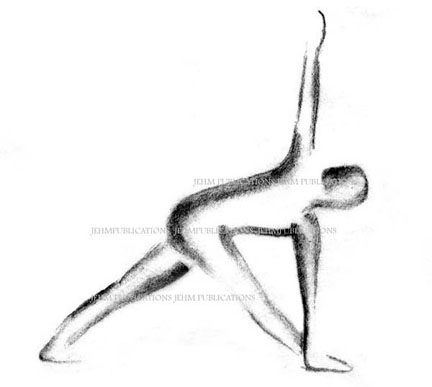
Utthita Trikonasana – triangle pose.” We were standing with our legs were spread wide, leaning forward, with one hand to the ground and the other stretched toward the ceiling. I suddenly remembered that you’re supposed to do yoga on an empty stomach.

The historian said the ultimate purpose of yoga had little to do with becoming fit and limber; it was really meant as preparation for the meditation that might lead one to uniting with the divinity inside each one of us. No wonder it was confusing in those yoga studios when the class ended and everyone leapt to make way for the next group coming in. Those last few minutes of silence and repose are much more important than all that comes before; they are, in fact, the point but that’s gotten lost in the emphasis on physical exercise and appearance.

The teacher walked between the mats, shifting a hip here and the angle of a foot there. I caught a glimpse of the clock. Just ten more minutes and one pose left. Good. The postures were no match for my chattering brain which pounced from commentary on the teacher; to rumination on the use of Sanskrit words when they’ve got perfectly fine English names for all the poses; to my assessment of my performance in comparison with those around me – better than the the guy in a baggy shirt but not even close to the pony-tailed woman in front of me; to a fixation on what the statue up front was (a skinny buddha – what did that have to do with yoga?); and then off again to the smell of the incense - was it bothering anybody? I could never use incense in my office without someone wheezing or gagging. And that summed up a scant thirty seconds of thought in a ninety-minute class.

But my hamstrings were better. I could feel that.

The instructor finally said, “Okay, lie down on your mats in Savasana, corpse pose.”

I dropped to the mat like a wet bath towel, making more noise than felt proper.

“Legs slightly apart, “ the instructor purred. “Then let them fall gently out to the sides. Let your arms fall alongside your body, facing upwards.”

I was whipped and warm, grateful for the stillness.

Within minutes, the teacher had us sitting up, legs crossed, palms together in front of our “heart space.”

Namaste

Namaste,” we repeated in unison. And then all around me, just as my mind chatter finally stilled, people began rolling up their mats and heading for their cellphones as the next class started to come in. I decided to go home to finish watching the documentary and what I heard next shocked me.

I’d gotten most of what I needed from the documentary – or so I thought – but I came home and, still in my sweats, sat there on the living room rug to finish watching the rest of the four-hour film on the history of yoga. And there, in the section on yoga’s journey west, was that yoga historian saying that the main people responsible for first bringing Hindu thought into this country were Henry David Thoreau and Ralph Waldo Emerson.

Thoreau and Emerson?

I’d read Walden Pond in both high school and college. I’d read Emerson in high school, college and many times since. I’d been assigned essays on both more than once. Yet I’d never noticed any of this.

Georg Feuerstein said that, while there was some evidence that Hindu thought was at least known by the ancient Greeks, it really wasn’t until the first English translations of the Bhagavad Gita, the Vedas and the Upanishads found their way into the hands of Henry David Thoreau and Ralph Waldo Emerson in the mid-1800s that these traditions had any significant impact in the United States. He said the Transcendentalists “were deeply affected by Indian thought. Thoreau openly uses words such as Brahman and words such as that.”

Of course Emerson’s “Over-Soul” was the Bhagavad Gita’s imperishable, unchanging “presence that pervades the universe.”
Within man is the soul of the whole; the universal beauty to which every part
and particle is equally related, the eternal One.
Of course, both Emerson and Thoreau stressed a direct, unmediated relationship with the Divine as Hinduism did in stark contrast to the religious practices of their day. Of course, Walden Pond was Thoreau’s Ganges, his time there his yogic retreat. In Walden, Thoreau had been explicit but, still, I hadn’t seen it, hadn’t taken it in.

In the morning I bathe my intellect in the stupendous and cosmogonal philosophy of the Bhagavat Geeta, since whose composition years of the gods have elapsed, and in comparison with which our modern world and its literature seem puny and trivial; and I doubt if that philosophy is not to be referred to a previous state of existence, so remote is its sublimity from our conceptions. I lay down the book and go to my well or water, and lo! there I meet the servant of the Brahmin, priest of Brahma, and ishnu and Indra, who still sits in his temple on the Ganges reading the Vedas, or wells at the root of a tree with his crust and water---jug. I meet his servant come to draw water for his master, and our buckets as it were grate together in the same well. The pure Walden water is mingled with the sacred water of the Ganges.
How could thought I’d considered so fundamentally a part of my heritage, so fundamentally American, have come, in part, from Hinduism? How could I have started this thing I’m doing with the most obscure, the most ancient, the most remote, the most exotic, the most unknown to me of the traditions and end up here? Inside the pages of some of my most treasured, well-thumbed books? And they were largely responsible for bringing Hindu thought to this country?

Emerson and Thoreau often get slammed for being so “self”-absorbed. This puts it in a different light, doesn’t it, if the “self” they were talking about was actually The Self? In other words, it's not them, in particular, they were trying to fully realize, but the Divine Self.

A few days later, I sat at the long wooden dinner table in the Vedanta Society's dining room after one of Swami Sarvadevananda’s evening classes when the subject came up of how Hinduism first came to the United States. Leslie, an American woman who was raised a Catholic but now wore saris from time to time, said, “It was Swami Vivekananda, wasn’t it? At the Parliament of Religions in Chicago the late 1800s?”

Swamiji’s Bengali-accented English is quite understandable but it’s easy to get tripped up, sometimes, by slight differences in syllabic emphasis. I’m really not sure if it was that or my assumption that the documentary had over-stated the case, or that I thought Hinduism had to have first come to the United States through the aegis of an Indian but I was thought I hadn’t quite heard him right when he answered, “No, it was Thoreau, Thoreau and Emerson who first introduced it here.”

“Thoreau? You mean Walden Pond Thoreau?”

“Yes.”

So here’s what I’ve learned about Hinduism so far: If you’ve ever participated in a Lamaze class or seen one on TV, if you think the state of your mind has some impact on your health, if you’ve been to a twelve-step program, if you are interested in astrology or meditation, if you think good or bad deeds might affect your future fortunes, if you can’t understand why such different ideas often seem to come from the crazy people in California, if you’ve read Ralph Waldo Emerson or Henry David Thoreau, and, most of all, if you’ve ever gone to a yoga class, Hindu belief, thought or practice has had some impact on your life.


(19 October 2006)

01 October 2006

Believers at war...

If I had chosen to go back to the Malibu Hindu temple, the one I first visited with Matt, instead of the Vedanta Temple, I might have ended up with Swami Sarvadevananda as my teacher anyway. He told me he taught a class there once a month so I decided to go.

The Malibu temple is right on one of the main roads to the ocean from the San Fernando Valley. I left plenty of time to get there – too much time. I settled in to one of the stuffed chairs in the nearest Starbucks to read Karma-Yoga and Bhakti-Yoga written by Swami Vivekananda, one of Ramakrishna’s monks who helped found the Ramakrishna Mission (known here in the United States as Vedanta) and the swami most responsible for igniting interest in Hinduism in the United States in the late 1800s and early 20th century.

The use of the word “yoga” is pretty confusing. What I know of yoga involves exercise but what I’m learning is that the kind of yoga most of us know is actually an off-shoot or descendant of one of the “types” of Hindu spiritual practice (there are four "ways" of worshiping the Divine for four different "types" of people.) In “Raja-yoga,” the path to enlightenment is through learning how to control the body. "Bhakti yoga" is the kind of spiritual practice most of us think of when we think of religion: the worship of Something. It's also called the path of love. "Karma yoga" is worship through work or doing one’s duty without regard for reward or a specific outcome – kind of like Mother Theresa. And the fourth path can be explained this way: if you’re reading this, you’re engaged in an act of “Jnana-yoga” or the path of knowledge. Hinduism says that while these four basic types of worship are open to every one of us, we each tend to be more comfortable in one more than the others.

The Karma path or the path of work, Swami Vivekananda described like this:
If you really want to judge the character of a man, do not look at his great performances. Every fool can act as a hero at one time or another. Watch a man do his most common actions; those are indeed the things which will tell you the real character of a great man. Great occasions rouse even the lowest of human beings to some kind of greatness; but he alone is the really great man whose character is great always, the same wherever he may be.
Kind of awesome, eh? But, as I continued reading in a strip-mall Starbucks a few miles outside Malibu, I stumbled onto this passage:
Every religion or country (has) only one way of loving their own ideal and that is to hate every other ideal. Herein is the explanation of why the same man who is so lovingly attached to his own ideal of God, so devoted to his own ideal of religion, becomes a howling fanatic as soon as he sees or hears anything of any other ideal. This kind of love is somewhat like the canine instinct of guarding the master’s property from intruders; only the instinct of the dog is better than the reason of man for the dog never mistakes its master for an enemy in whatever dress he may come before it.
I wanted to stand up in the quiet Starbucks with its little pods of people tucked in to themselves and grab every one of them, to point to these words and shout: "That’s it! This is it, the answer – or at least part of the answer – as to why supposedly devout people hate other faiths and the people who believe them. “They” have to be wrong – or I am."

Could this be one idea, anyway, of why some people of faith find themselves wanting to fight with others of faith?

I wonder what would have happened if I had done it, if I had run all over the Starbucks reading this passage out loud? Polite staring. Uncomfortable rustling. Packing and leaving. Who wants to be confronted by a crazy woman while sipping a latte on a cold gray day? Not the sleek woman with hair pulled back and the yoga mat bag under her arm. Not the loners perched in front of their laptops and stained paper coffee cups. Not the weekend father with his thirteen year-old daughter who made the small round table between them look like a continent. Well, maybe them. At least they would have had something to talk about. But the truth of the matter is: along with being afraid of annoying strangers, I also worry about seeming stupid, about revealing just how little I know, especially when I get embarrassingly excited about learning something new only to find out it’s been obvious to everyone else for years.

But how much of my life have I not lived because I’ve been afraid of appearing stupid?

All I know is: I can’t care if I look gullible or stupid or credulous anymore. I must know why so many of the people whose planet I share, feel so threatened they see killing others as a reasonable, faith-based choice. I must find a way to feel some tiny part of their passionate belief, to see for myself how one might end up like that. And Swami Vivekananda’s idea – that we constantly mistake other’s beliefs as a threat to ours when they may simply be the same thing just in different garb – feels, at least, like the beginning of an answer.

26 September 2006

Swami Sarvadevenanda


Atman cannot be attained by speech, by the mind,
or the eye. How can It be realized in any other way
than by the affirmation of him who says: “He is”?

Katha Upanishad, II.iii.12
I wanted to get a closer look at Swami Sarvadevananda, to find out if he really was The Guy - but I wanted to be invisible while I did it. I felt like a skittish animal peering out at someone from the edge of forest: Is it safe? Does he have food? Will he hurt me? The website of his temple, The Vedanta Society, said he was scheduled to teach an evening class and that seemed like cover enough. It turned out that, after searching in temples all over southern California, I was headed to a temple I could almost walk to from my office. The Vedanta Temple is right near the 101 freeway but you can’t see it because it’s on a small hill surrounded by trees.

The white temple with leaded glass windows sits next to a dark house that serves as office and bookstore. Inside, the chapel is spare with cream-colored carpets, walls and nave. Oak pews with cushions stop at about the middle, leaving room to sit on the floor in front of the steps up to the altar which is deep in the back. The display is much more subdued than the other temples I’d seen; instead of many large life-sized deities, there’s just a wooden stand with three photos on it – one higher than the rest - and a lot of flowers.

A silent meditation was just ending when I walked in – I really should say burst in. I could only see that the room was dim but nothing more through the rippled glass door. I made more noise than I wanted to finding a seat but, as soon as I settled, a white man of about sixty with a grey beard came in, much more quietly than I had, wearing his office clothes. He must have known the drill. He put down his black briefcase by the back door and walked straight up the aisle until he was standing before the carpeted steps leading up to the altar. Once there, he got on his knees and then bowed down long and deep. Sitting up, he then bowed again. And, with that, he stood up, walked back down the aisle, scooped up something small from the tiny covered brass dish on the table by the back door, picked up his briefcase, and walked out. He seemed like he was stopping by from work on his way home just to say hello, to acknowledge a revered elder as if the photographs were real people. The visit seemed to make him happy, content, a peaceful end to a long day.

The worship of people who lived recently enough to be photographed makes me nervous – not that devotion to mythic deities is much easier. Maybe I’ve just covered too many conmen in my old job as an investigative reporter but I’m always on the look out for someone playing a role to get something from others, to get something from me. Not the best attitude when you’re trying to wrestle with matters of faith, I think…or maybe it is. I dunno. But it is a fact that my first reaction, my first action, my first thought is to try to figure out if someone I’m talking to is a fake and this obsessive focus on the veracity of others often gets in the way of my even getting a clue about what I think and feel. But, sitting in the quiet, the photographs suddenly struck me as no different than the photographs on my mantelpiece of the people in my life whom I loved and revered. From looking at my father-in-law’s broad open Irish face, a face almost precisely mirrored in my son, Matt’s, I get a sense of compassion and service, of humility and deep love. From the photograph of my difficult but vibrant mother-in-law, I feel a sense of fire and perseverance while, from the hurt eyes of my grandmother at five, comes a call for unconditional love.

Okay, so the photographs on the altar in temples are draped with garlands of fresh flowers and candles and people were bowing down before them but it doesn’t seem like they’re being worshipped like deities so much as way-showers, people who, by example, truly lived the spiritual practice in a way that still motivates some. So why should these photographs or icons give me so much trouble? I think it’s much easier to accept a representation of Jesus or Buddha because no one really knows what they actually looked like so they’ve become an idea bigger than a single human being. I mean, I find it much easier to see the divinity in every person (well, most of the time) but I get hinky when one actual person is literally put up on a pedestal.

Moments before the class was to begin, I ran to get something from my car. In the quick dash out and back, Swami Sarvadevananda, draped in light orange fabric, had come in. He was sitting on the floor of the carpeted stage, his legs under a small table that held a book, a lamp, and a microphone. I slipped into the second pew, behind a handful of others, and discovered that I’d run back in with my shoes on. A glaring whoops. I pushed my shoes forward under the pew in front of me, hoping no one noticed.

Swami Sarvadevananda was cheerful. “Well, it’s 7:30. I guess everyone’s late but let’s start, shall we?”

From twenty feet away, Swami Sarvadevanada could be mid-fifties, perhaps early sixties. He's thin, with a dark, somewhat random head of hair and an open, playful face announced by almost absurdly large glasses. He seems perpetually on the verge of smiling.

I hadn’t bothered to look at what tonight’s topic was supposed to be. It was Raja Yoga, one of the four basic paths to enlightenment in Hinduism. For us in the west, although we’re unlikely to have heard the term “raja yoga”, it’s probably the most familiar path as it’s the path that includes what’s known here as yoga, meditation, and the exercises that lead to the ability to control one’s body for the purpose of coming to experience the presence of God – the part of Hinduism I’d been hoping to avoid - not the meditation part but the body-control stuff. I don’t know what religion or the practice of faith has to do with theories of how bodies work.

“When we’re talking about prana, about taking in prana.” The swami inhaled deeply. “Most people think we are talking about the breath, about controlling the breath. No. It’s energy, it’s really energy. By controlling the breath, we are controlling the muscles that contract the lungs and that means you are controlling your energy. If we control our energy, we control our body. If we control our body, we believe, we can control the whole system.”

His hands were the most elegant thing about him: when he spoke, one of them usually traced graceful serpentine figures in the air, his long fingers close together, his palms turned over as if offering something from a pocket – if he had any. “Let me explain. Most people think they can’t move their ears. But we know some people who can. We can’t simply because it’s a skill we haven’t developed because we don’t practice it. But we have the power to do anything inside of us. It’s all potential power, power that we can realize by practicing control.”

The swami pointed out that when we held our breath to move a heavy object that was an example of an unconscious use of raja yoga, of controlling our energy.

As he went on to give examples of healing and healers, I found myself veering off into judgmentland. I mean, what he was talking about, these particular Hindu beliefs, were the root of much of what people consider nutty about California: energy healers and crystals and alternative medicine, etc. My doctor’s-daughter mind balked. I mean, I get why meditation and the practice we know here as yoga could be considered antidotes to the frantic stress of our lives. I meditate but I don’t make a big deal of it. I feel better when I do it; simpler, less jangled. And, like many people, after learning that middle-aged bodies need stretching along with running and lifting weights, I go to an occasional yoga class. Not only do these practices no longer seem strange to me, even western medicine acknowledged their usefulness. But it’s difficult for me to go much further than that.

“Energy can be transferred from one person to another. When we are near a powerful person, we feel the power. Similarly, have you ever been with someone who just took all the energy out of you, dragged you down? When we hear a speaker who touches us, who speaks with enthusiasm, with passion for what they are saying, we are touched. We really learn something. We say: ‘they really talked from the heart.’ It’s just the language that we use but what we’re talking about is pranic energy. All we’re talking about is that they were a conduit for the energy that is all around us all the time to flow through them to us.

“The whole world is nothing but energy. You are energy, I am energy, words are energy… I mean, all I’m saying is energy and nothing else but that. And there is only one energy, one prana and we are but individual expressions of it. It’s like a vast lake; if you throw a stone into it on one side, the ripples will be felt on the other shore so long as you’ve got instruments sensitive enough to measure it. So, if we heal ourselves, we can affect the people around us. The great healers – Jesus, Buddha - all knew this. What did Jesus do? He said, ‘Take up your mat and walk.’ Buddha knew this and he healed people.

“Now it’s not so easy to be such a healer. There are some people who take advantage of the innocence of normal people and pretend that they are healers!”

Now he was talking my language. It wasn’t until Swami Sarvadevananda acknowledged the existence of fakers, of people who misuse others’ faith or desperation, that I began to relax.
“Why is it that Sri Ramakrishna,” the swami said with a gesture towards the top picture on the altar, “that Christ, that Buddha have had so much influence on people all over the world? It’s because they raised their pranic energy to a level that they can awaken the cosmic pranic energy. If you are ready, you can feel this uplifting energy when you come close to this vibration. You have the power, the potential, inside of you but it must be awakened.”

So, that was the name of the man in the photo: Ramakrishna. But there were two others down lower. None were easy to see in detail from where I sat.

Swami Sarvadevananda ended the class with some chanting.

I ducked down behind the first pew to pick up my shoes when it was over and, when I came up, I found the swami standing right in front of me. Me. He began talking as if I’d already asked him a question when I hadn’t said a word. “Yes?” he said. “How can I help you?”

Did I have a sign on my head? On my face?

“I’m a writer working on a project and I’d like to come talk to you.”

“When?”

“As soon as it’s convenient for you.”

“Why don’t you stay for dinner? Follow those people, they’ll show you where to go.”

“Okay.” With that, I dropped the books in my arms and some of the contents of my purse at his feet because I was trying to hide my shoes underneath the books in my arms. He said nothing, nor did he embarrass me by bending down to help me pick any of it up. He turned and walked to the back of the chapel to greet people. One after another, almost all of them bent down to touch his feet, even the American ones. So it wasn’t just Hemu’s temple then. I headed out the back door and into the cold night, following a couple of people around the back of the building.

The sun was gone. I walked down a dimly-lit brick pathway and up a few steps into what looked like another, newer house.

I was beginning to get it: eating was clearly a very big thing in Hinduism. Everything ended with a meal – even the rituals in the temples ended with eating things. By leaving the mandir in Whittier without taking food, I was, in some sense, being quite rude. Well, maybe not rude but I was rejecting part of the practice. I never think about food as ritual, as part of a spiritual practice; for me, it’s an afterthought, something dispensable. I even think I’m being nicer by not staying, not imposing, not requiring work on my behalf. And I’m always in a hurry to get home as any “extra” time spent away from my family feels wrong.

That night, I accepted the invitation but I had my internal meter running.

On the long wooden side board, were bowls filled with rice and various simple dishes – including fish. I got my plate and Swami Sarvadevananda said, “Sit there,” motioning to a seat near his place at the end of the long table, capable of seating perhaps two dozen people, too large for intimacy but too small for anonymity.

It took me a moment to notice I actually knew the woman sitting between the Swami and me, an acquaintance I’d met through a friend years ago. When the Swami came to the table to sit down, ready to hear me out, everyone stopped talking to listen to what I had to say - not exactly the scene I’d imagined or wanted.

Describing this project isn’t easy under the best of circumstances, let alone in front of a table full of strangers. I stumbled through it and heard myself stress that my parents thought religions were “the root of all evil, the cause of strife and dissension.” I know I must have said more but those were the words still clanging in my ears days later. I had no idea how the other people at the table were reacting, I couldn’t look at them.

When I was done, the swami said, “Okay, when do you want to come?”

“As soon as possible.”

“Tomorrow at five?”

“Okay.”

And then the swami turned from me to the thin Indian man with salt-and-pepper hair beside me and said, “Are you staying with us?”

My acquaintance, a pale, freckled woman named Leslie said quietly, looking at her plate. “That sounds like an awesome idea. A really, really great idea.”

With relief, I answered, “Thanks.”

I’d finished eating the small amount of rice and vegetables I’d taken while the table full of people who didn’t know each other managed to patch together a kind but somewhat awkward conversation. It felt a bit pushy to ask any more questions so I’d decided to just sit and listen when the swami, again, turned directly to me without my saying a word and said, “You can leave if you want to go. It’s all right.”

Before I left, I handed him my proposal for this project in which I described my background and what I was planning to do; I wanted to make sure he knew exactly what he was getting himself into with me. The swami said, “Oh! I’m not sure I’ll have time to read this but, if not, you can just tell me tomorrow.” He turned to the people who were just starting to clear their places and said, “Now, if anyone wants to work on their karma, the kitchen could use some help cleaning up!”

And he was gone.

I’d found my teacher.


(26 September 2006)